
THE MAN FROM SNOWY RIVER, a far, far-Western from the frontier past of Australia made a rowdy transoceanic splash in 1982, its old-fashioned, family-friendly saga of tough men and wild horses in a ruggedly beautiful landscape not only a cultural touchstone hit Down Under but a rouser that captured crowds and critics in the States. John Dixon’s screenplay was based off the 1890 poem by folklore icon Banjo Paterson. *
The 1880s, the Australian Alps. After his father is killed by a stampede of brumbies (feral horses) young ‘Jim Craig’ (Tom Burlinson, 25) has to prove to regional mountain men that he has the right to run a station. He’s grudgingly hired by ‘Harrison’ (Kirk Douglas) a brusque, well-off American ex-pat. Harrison’s attitude toward Jim isn’t helped by Jim’s friendship with miner/hermit ‘Spur’ (Douglas), his estranged brother, nor by Jim’s finding favor with ‘Jessica’ (Sigrid Thornton, 22) his comely, headstrong daughter. Resolution of people problems ultimately rests with the herd of untamed horses, led by a fierce, nearly mythical black stallion. Mount up!

The basic set-ups are hardly surprising: prove your manhood, outfight a scruffy, jealous windbag, win the damsel—all ranch girls in movies are ‘headstrong’—and out-ride everyone in the state/territory/hemisphere. Done well, like this, familiarity is comforting. For pride-infused native audiences this was a sure bet; across the pond Americans were not only in thrall with Australian movies and enamored of frank Aussie attitudes in general but were up for something mindful of our frontier roots (in movies, if not actuality), especially you were left feeling good when the show was over.

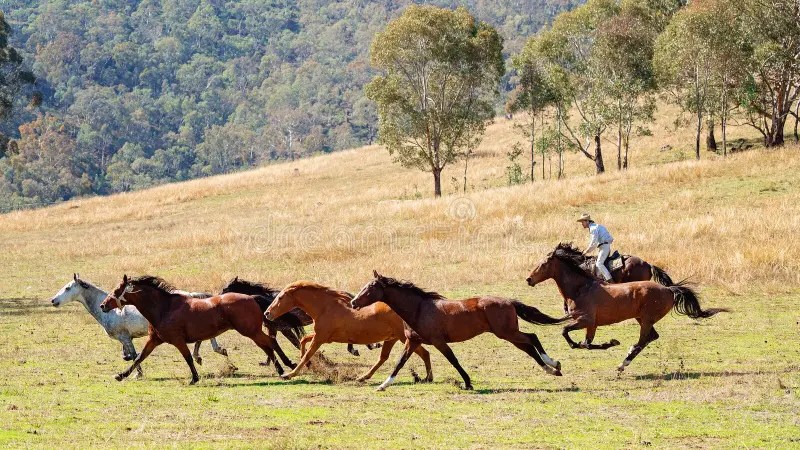
Burlinson (who was a novice horseman—you’d never guess) and Thornton make an appealing couple, the supporting cast is hardy and Douglas, 65, enjoys himself in the dual roles, and doesn’t over-Kirk it. Bruce Rowland gives it a pleasing score. The standout selling points are the stunning mountain scenery (Keith Wagstaff, cameraman, he’d later serve mini-series Eureka Stockade and Anzacs), the atmospheric costuming and sets and above all the breathless sequences with the livestock, featuring not just some sleek equines at full tilt but wild pell-mell riding and wacky stuntwork.

Directed by George Miller (often confused with fellow Aussie and same-named director of ‘Mad Max’ glory). Made for $3,500,000, with the actual Snowy Mountain settings nixed in favor of shooting in the neighboring Victorian High Country. US attendance notched 34th in ’82, the $27,400,000 more than half the worldwide gross, Australia naturally enough accounting for a third of that total.

“‘Go West, young man! Go West!’, they said. So I did, 10,000 miles further than they intended.”
115 minutes, with Jack Thompson, Tommy Dysart, Tony Bonner, Chris Haywood, David Bradshaw (as Banjo Paterson), Terence Donovan and Gus Mercurio. Filmed first as 1920 silent, in 1988 a sequel turned up, released in the States as Return To Snowy River.

* Banjo Paterson (1864-1941), bush poet, journalist, war correspondent, author and soldier, is a bedrock figure in Australian national identity. His most famous piece is known and loved around the world: “Waltzing Matilda”. Slap down payment Down Under for a cold brew and chances are you’ll be looking at Banjo.
Audiences in the United States were pre-primed for antipodean talent when this racked up, having been stoked by Picnic At Hanging Rock, Breaker Morant, Don’s Party (yes!), Max Mad, The Road Warrior, Gallipoli and The Year Of Living Dangerously. The sort of invasion you welcome: it’s never stopped giving.
Westerns were an endangered genre at the time: The Grey Fox (made in Canada), Barbarosa (directed by an Aussie) and The Ballad Of Gregorio Cortez were lonely hombres on the trail.
 Movies ala Mark