
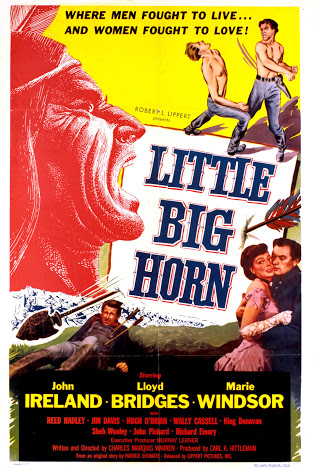
LITTLE BIG HORN, a war film (sacrificial patrol variety) disguised as a 1951 western, gives away the game at the tail of the opening credits (flag flapping to a dreadful song) with the foreword “from such incidents has risen the greatest fighting force in the world today—the United States Army (highlighted)—to which this picture is respectfully dedicated.” Well…*
1876. Informed that their commander, George Armstrong Custer, is leading his forces into a tornado of Indians, an outlying patrol of the 7th Cavalry makes a desperate 3-day run to try and warn him. “None of us are fit to ride 50 miles, let alone 250. But we’re gonna do it. And we don’t have time to go around obstacles. We’ll go straight through them, no matter what or who they are.” Sounds rugged: just skip the thought that horses would be hard tried to make 40 miles a day let alone 83. And given the continuing dawdling to talk over their personal problems, the script (written by Charles Marquis Warren) is asking more of us than its troopers. Warren also directed (his debut in that job), with a helpful assist from cameraman Ernest Miller (he shot 17 movies in ’51 alone) seeking to pass off backlot sets and Chatsworth, California scrub brush and boulders for the Black Hills, 1,300 miles to the northeast. The kids won’t notice.
From 1945 to 1956 Lippert Pictures put out a slew of low-budget B-pictures. Most were junk, a few (The Steel Helmet, Rocketship X-M) outperformed their budgets and scored higher. Little Big Horn drew notice (and still does, way beyond its weight) since it featured a hardy cast of familiar faces and counted coup at the box office. Taking 225th place doesn’t seem like much of call to arms, but a $500,000 gross wiped out a bare-bones budget of $184,849, and gave Warren rein to direct more, mostly spendier features; alas, none of them memorable.

Your humble barracks buddy first saw this compact 86-minute item as a tyke and recall liking it, even if the ending (no big battle, what the heck?) was what we used to refer to as “a gyp”. A fresh look was of mild interest for the sturdy cast, and for noting how the rep for the little exercise has been inflated beyond its due, garnering a devoted fan base that includes a number of critics (not wanting to be left out of the ‘re-discovery’ zone). It…ain’t that good.

Do you mind waiting at least until I’m out of the room?
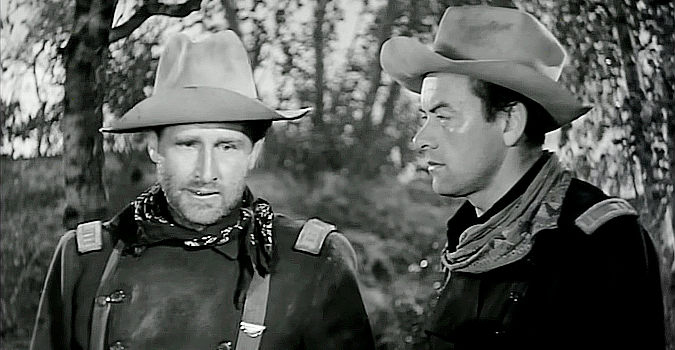
‘Capt. Donlin’ (Lloyd Bridges) is duty-bound to help Custer, but he’s also hell-bent on dragging ‘Lt. Haywood’ (John Ireland) to a rendezvous with glory since—back at the fort—he’d red-handed caught Haywood in a heated clutch with his spurned wife ‘Celie’ (sultry B-fixture Marie Windsor) and payback is—well, a madcap trot into 4,000 ticked off Sioux and Cheyenne. The 15-man patrol loses a few on the way (in skimpy, badly staged skirmishes) but not before every man in the outfit has a chance to complain, worry, talk about women, buck up, and pull on the boots to die with. They include then-new faces who’d become fixture faves, including Jim Davis, Hugh O’Brian and Sheb Wooley. Within a few years O’Brian would find TV lawman fame in The Life and Legend of Wyatt Earp. Late career success (also on the boob tube) came to the rugged Davis via the modern western of ‘civilized’ Dallas. Former Oklahoma cowboy Wooley (of “Purple People Eater” fame) was elevated from scout in this saga to playing Custer (with the requisite buckskin jacket) in the following year’s Bugles In The Afternoon, one of at least seven 7th Cavalry-oriented features that popped up during the decade. Take it from someone who died (heroically) a thousand times in the backyard.
With Reed Hadley, Wally Cassell, King Donovan, Richard Emory.
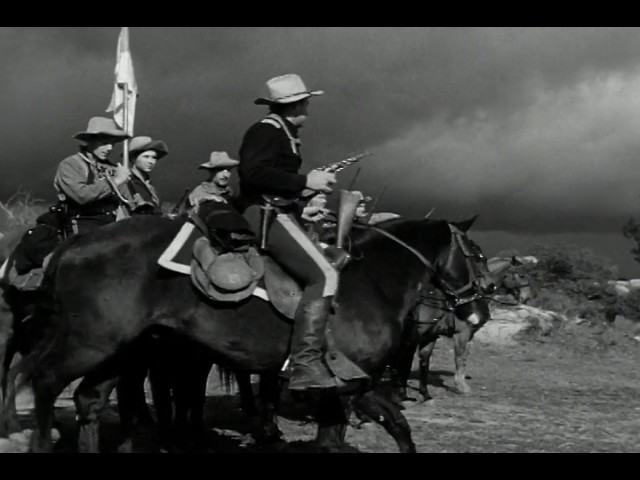
* It wasn’t just the success of John Ford’s trio (Fort Apache, She Wore A Yellow Ribbon, Rio Grande) that ushered in a decade & and half of ‘cavalry’ westerns, it was the military worship hangover from WW2 that made Frontierland soldiers so popular. That gallant foreward (ho!) in the credits is noteworthy in that (a) the “incident(s) like this” was a catastrophic bungle and massacre (b) the Korean War was on full grim tilt, one that began with our guys getting humiliated, twice (first by the North Koreans (MacArthur asleep at the wheel), then the Chinese (MacArthur again), and (c) the Russians and Germans might raise battle-worn eyebrows at that “greatest fighting force in the world” jazz. Relax, keyboard warrior: we’re not slamming “the troops”, just re-mulling the decades of ‘training’ and endless ‘mission’s against ‘savages’.
 Movies ala Mark