
APOCALYPTO proves that—whatever else he may be—Mel Gibson is one hell of a director. He also produced and co-wrote (with Farhad Safinia) this grueling, stunningly visceral 2006 epic, a $40,000,000 reimagining of life and death in the Yucatán of 1502. As in the mighty Braveheart and mighty controversial The Passion Of The Christ, the boldly unflinching Mad Mel displays a raw gift for conjuring up the look and feel of people and days of (way)old. Whether you think he privately might want to live in them depends on how much you feel like indulging specious speculation on the guy’s volatile character. The walking woke may as well abandon ship. More air pockets for the rest of us savages. *

In the seemingly boundless, unforgiving yet life-sustaining jungle of Mesoamerica, the communally content hunter-gatherer tribe of ‘Jaguar Paw’ (Rudy Youngblood, debut) have their world suddenly, horrifically upended when attacked by Mayan raiders, who brutally abduct those they don’t mercilessly kill. After arrival at their tormentor’s city, the captives are to be used as human sacrifices. Jaguar Paw barely escapes, pursued by vengeful warriors as he undergoes a wild survival run through the forest, hoping to find his pregnant wife and little boy who had managed to dodge the attack.

Though it opens with a quote from historian Will Durant that “A great civilization is not conquered from without until it has destroyed itself from within“, hinting that it’s a cautionary fable, that and fidelity to cultural anthropology take a back seat to what’s essentially a riveting chase adventure echoing classic run-for-your-life stories like “The Most Dangerous Game” and The Naked Prey. Run, hide, fight. Location shot in the Mexican state of Veracruz and in Guatemala, using a Native American and Indigenous Mexican cast, it wisely went for subtitles, the actors speaking Yucatec Maya. **

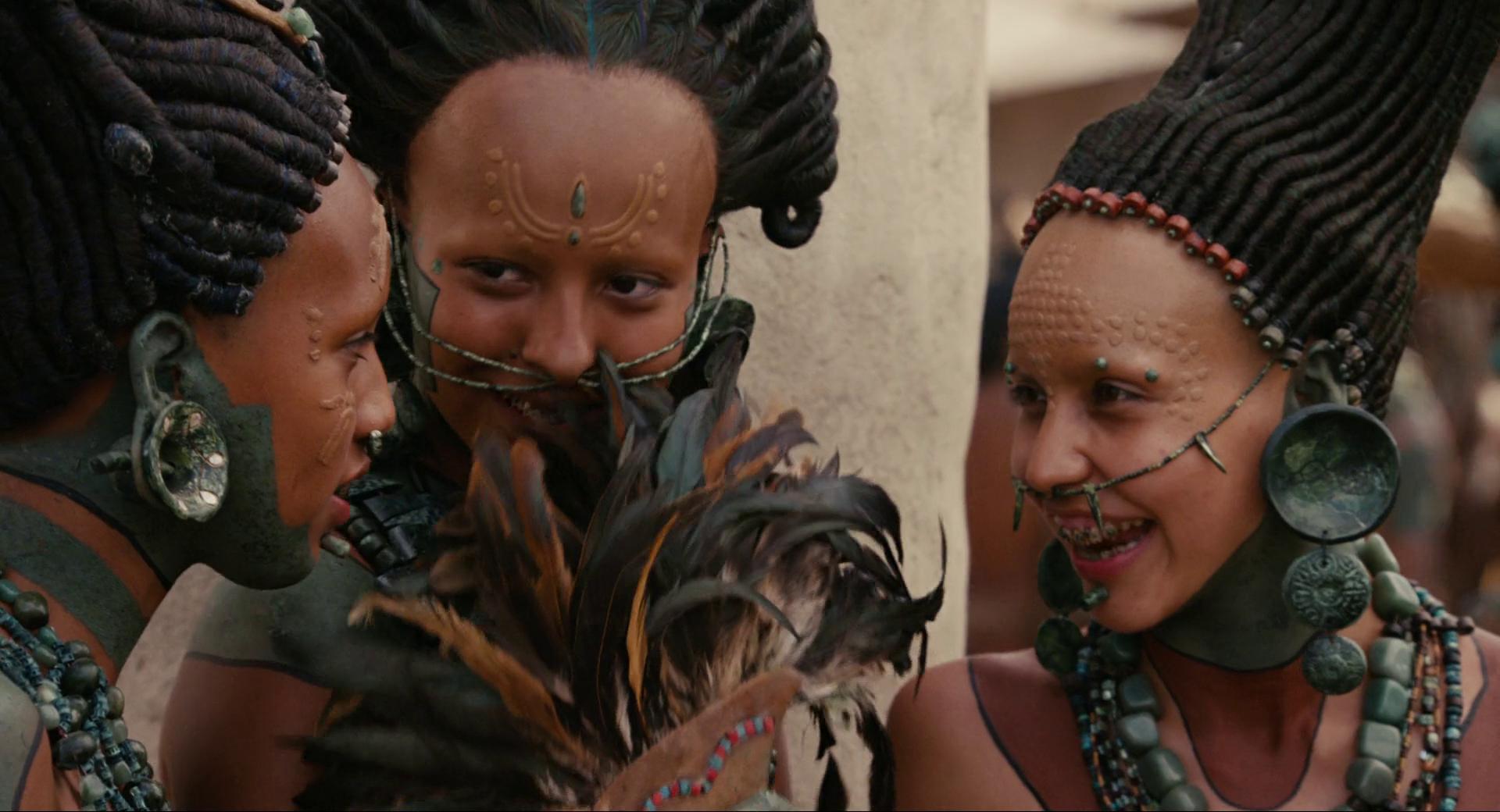
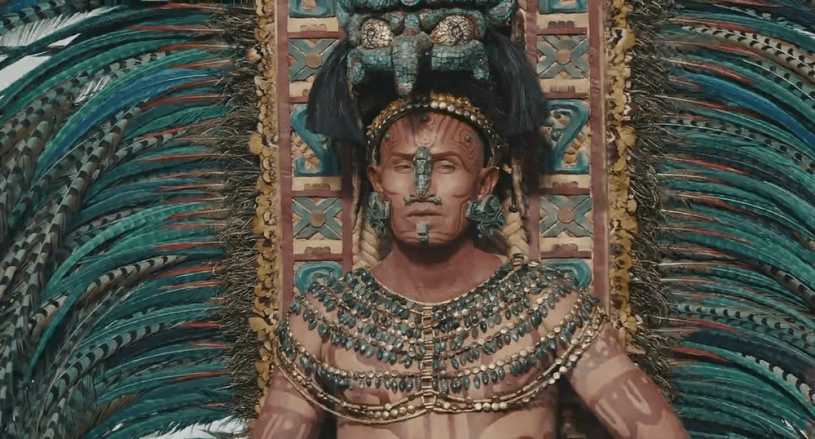
Everyone is first-rate. Standouts are Raoul Max Truhillo (‘Zero Wolf’) and Gerardo Taracena (‘Middle Eye’), playing two of the fiercest villains you wouldn’t wish on your worst enemy (okay, that’s too nice—‘worst enemy’ pretty much begs for it). As with his forays into Medieval Scotland and Ancient Judea, Gibson’s eye for casting, crafting of performances, martialing of crowd scenes and attention to detail is exemplary. His huge crew of costumers, prop and set designers and makeup staff do outstanding work.
Academy Award nominations went to Makeup, Sound Editing and Sound Mixing. The global gross tapped $120,673,000, 42% of that in the States, where it placed 63rd.
‘”Then the owl said to the other animals, “Now the Man knows much, he’ll be able to do many things. Suddenly I am afraid.” The deer said, “The Man has all that he needs. Now his sadness will stop.” But the owl replied, “No. I saw a hole in the Man, deep like a hunger he will never fill. It is what makes him sad and what makes him want. He will go on taking and taking, until one day the World will say, ‘I am no more and I have nothing left to give.'”
Sterling cast includes Dalia Hernandez (‘Seven’, Jaguar Paw’s wife), Jonathan Brewer (‘Blunted’, amiable butt of jokes), Morris Birdyellowhead (‘Flint Sky’, tribal leader), Iazua Larios (Blunted’s wife ‘Sky Flower’), Maria Isabel Diaz Lago (the hectoring mother-in-law), Fernando Hernandez Perez (the high priest), Rafael Verez (the king). Music score by James Horner. Cinematography by Dean Semler. 139 minutes.

* Some of the frothing, tiresomely expected kneejerk reactions to this movie, over either its component parts or as a whole, are astronomically idiotic. We won’t waste space arguing with zealots convinced of their intellectual, ethical and humanist superiority, but for Goad’s sake we’ll post a pithy pass we from one nameless fed-up fan: “Yes, Mel Gibson hired hundreds of indigenous people to make a film set in ancient Mesoamerica with no spoken English because he wanted to have a very short scene at the end to say colonialism was good.”
The Mayans, dating as far back as 2000 B.C., have been ignored by film-makers. In 1963 there was the campy spectacle Kings Of The Sun, and in 2013 the Guatemalan production Dónde Nace El Sol (Where The Sun Is Born).

 Movies ala Mark