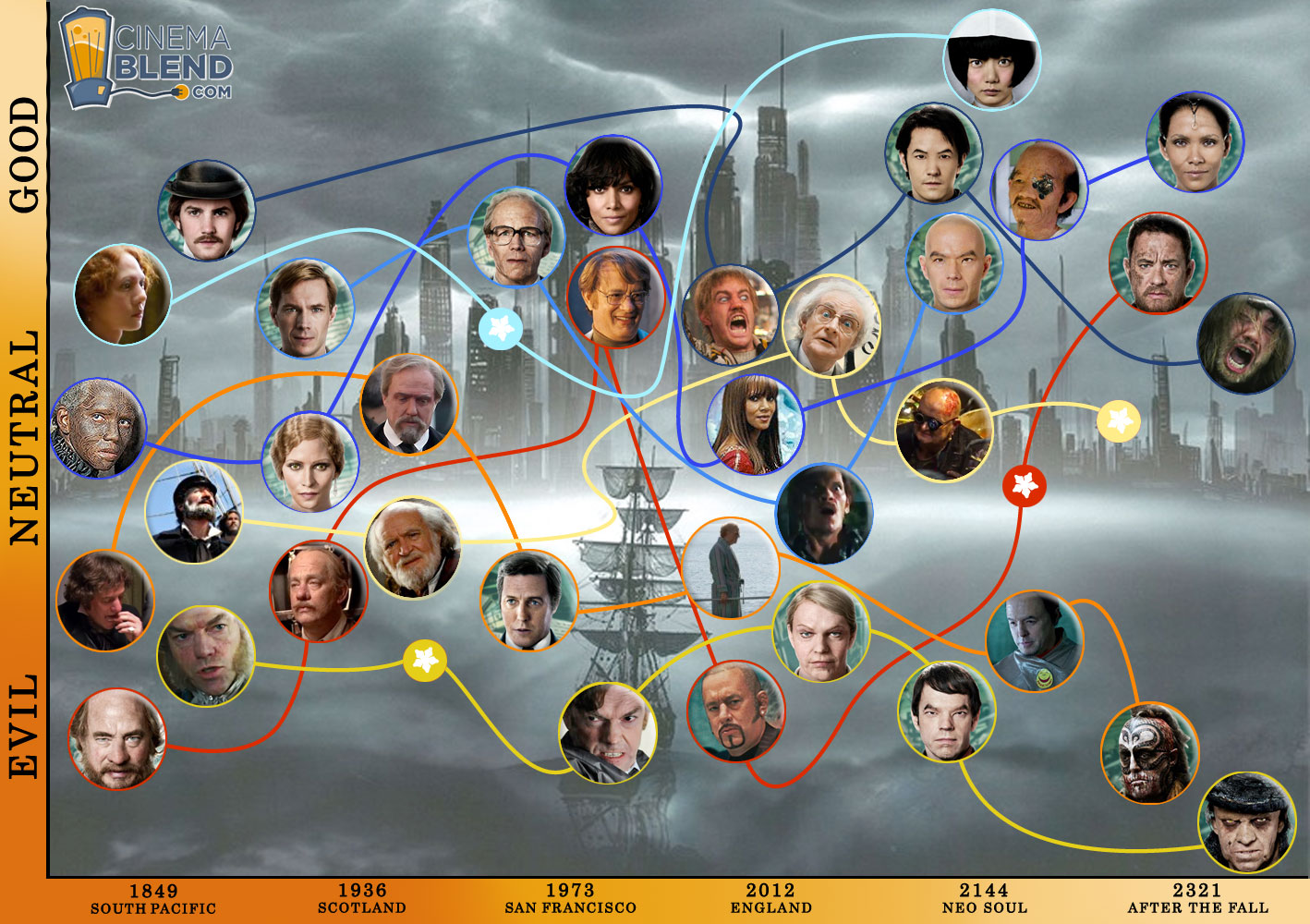
CLOUD ATLAS floated into 2012, the year that Apocalypse acolytes fretted/prayed was destined to spell planetary doom. Though working on it feverishly, we’re still here, but in the accounting dungeons of movie studios, this multi-century epic was the third leg of a science-fiction stool that collapsed into steaming ego pools of faulty design, joining John Carter and Battleship as fable faceplants on a grandiose scale. Collectively the trio lost a half-billion bucks. They may as well have been overseen by the Pentagon. Yet you miss one lousy payment on a credit card…
David Mitchell’s “unfilmable” (a term invented for a reason) 544-page novel was adapted into a screenplay by Lana Wachowski, Lilly (then Andy) Wachowski and Tom Tykwer: all three directed, filming on locations in Scotland, Spain, Malta and Germany. They were also among 25 producers of various capacity, aided by 24 assistant directors, 53 makeup personnel and more effects creators than the population of Belgium. Tykwer, Reinhold Heil and Johnny Klimek composed the music score, the inarguably lush cinematography was shared by Frank Griebe and John Toll.

Trying to sum up the plot almost requires taking out a student loan. Six scenarios, each set in a different time period and geographic location, interconnect to spiderweb together an insistently gloomy meditation on reincarnation causality linking at least 69 characters over five centuries, with 14 actors playing multiple roles (those 53 makeup artists kept busy), many of them showing up as six different people, changing races and sexes, alternating between villains and victims, heroes and bystanders. Eight minutes shy of three hours are consumed.
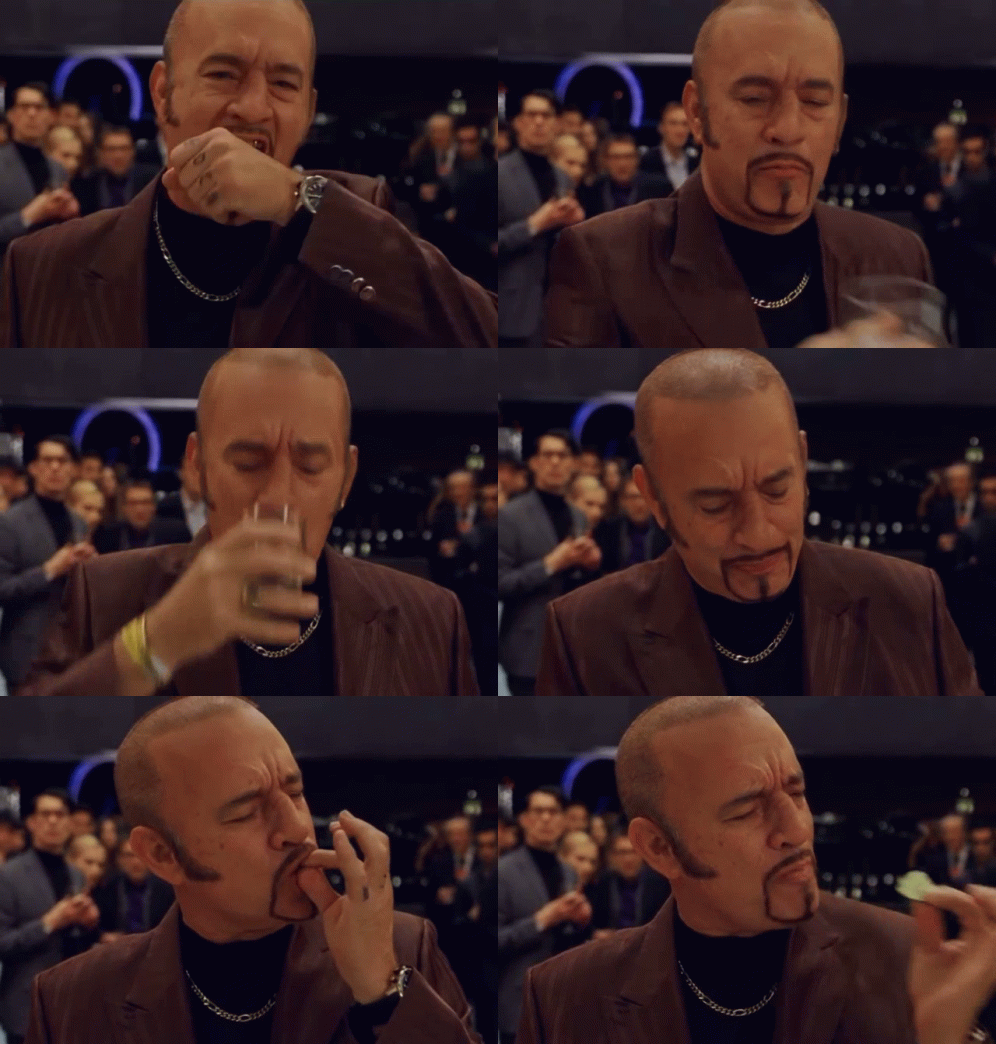
“Every time she brought up any of the karma, past life stuff, I–I couldn’t stop myself from laughing.”
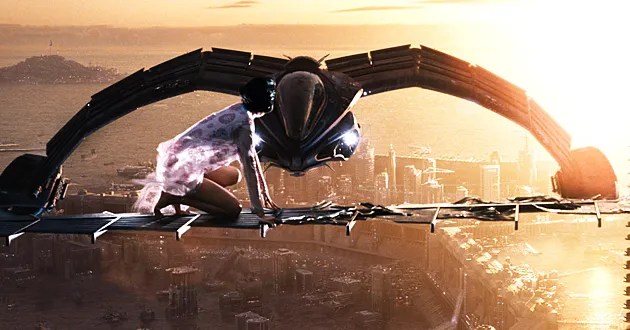
Settings: Chatham Islands (near New Zealand) in 1849; Cambridge and Edinburgh, 1936; San Francisco in 1973; London, 2012, ‘Neo’ Seoul in 2144; Hawaii in 2321.
Leads: Tom Hanks, Halle Berry, Hugo Weaving, Hugh Grant, Jim Broadbent, Jim Sturgess, Ben Whishaw, Doona Bae. Tagging along: Susan Sarandon, James D’Arcy, Zhou Xun, David Gyasi.
The sort of project that’s irresistible for actors—“You play six different parts! In interviews and on the disc extras you can go straight-faced plural with ‘My characters’ before you mention ‘process’ and try to say something different than your co-stars about the director’s ‘generosity’, ‘genius’, etc.” As for the performances, Weaving and Grant come off best.
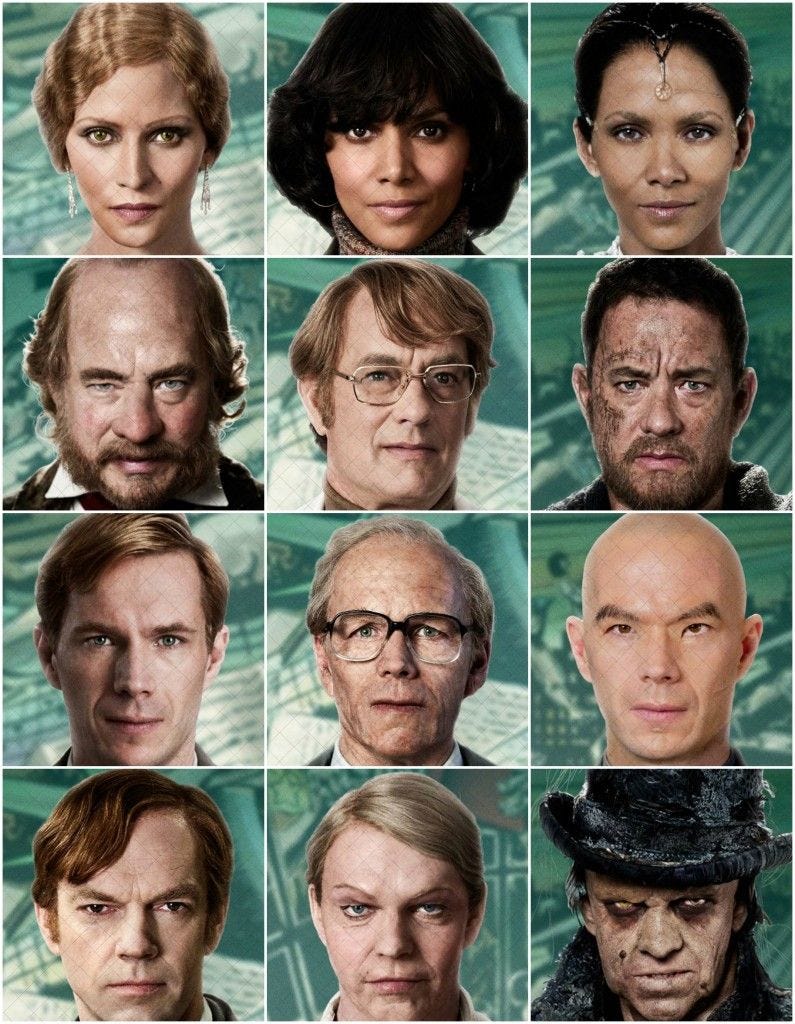
Who are Hugh?
The budget was at least $102,000,000 (possibly as much as 31% more, it’s cloudy—hey, that’s funnier than anything in the script), not counting the marketing tab. The return was clear and cold: $130,483,000 worldwide, of which just $27,108,000 was in the States, where its storm of impressive imagery and squall of inchoate ideas evaporated at 98th place. The post-tempest rainbow is in a dedicated cult following.
For this hopeful skeptic, the movie wasn’t cloudy but foggy. Laudable ambition, exasperating execution. The first attempt had me bail out after 45 minutes. The second go held interest for about half of it, replaced by dejection after seeing one character after another subjected to cruelty and humiliation. Had to insert my own intermission, to search the medicine cabinet for something to sooth eyeballs from excess rolling provoked by so much pretentious ‘heavy’ dialogue. Finally, surrender—akin to captivity, wondering which would end first, the 172-minute running time or my life span. In the future (not quite as far off–or out–as Neo Seoul) we’ll tackle it again to try and see more of what its fervent admirers do. Applied hallucinogens might help. Meanwhile, reel in the chain which was pulled into next week. Or life.
 Movies ala Mark