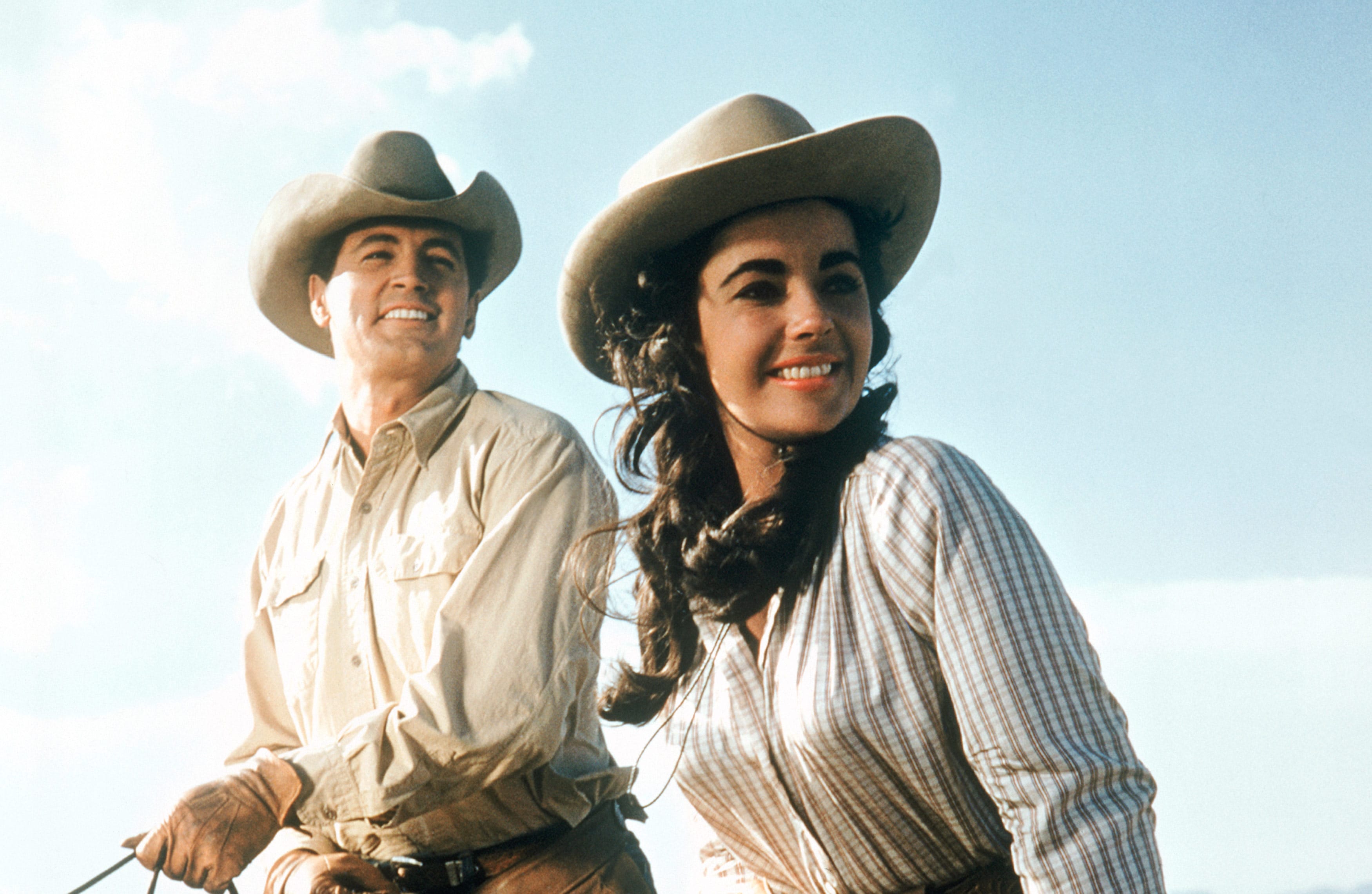
GIANT announces its 201-minute family & culture saga with a triumphant blast of music courtesy of composer Dimitri Tiomkin, one of the masters of Big Movie scoring, a soaring choral expression fusing past, present and presumed future together: Texas as Titan. The three hours and 19 minutes that follow took producer-director George Stevens and crew 145 days to shoot, and a year to edit 860,000 feet of film. The $5,400,000 look at pride & prejudice, Texas style, became the 3rd biggest hit of 1956, and secured lasting sentimental staying power in the roll call of cinematic Americana.
“You sure do look pretty, Miss Leslie. Pert nigh good enough to eat!”
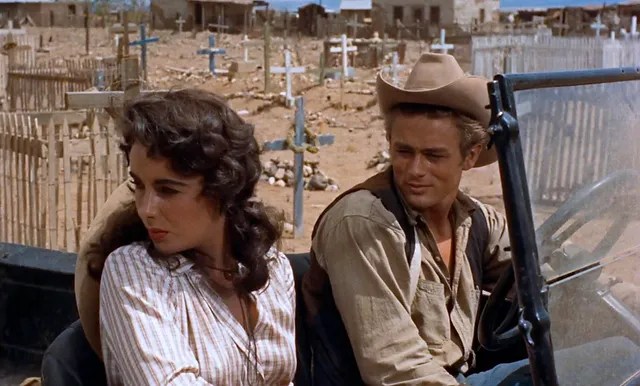
The sprawling script Stevens directed, written by his longtime associates Fred Guiol and Ivan Moffat, was adapted from Edna Ferber’s 1952 bestseller, covering a quarter century (mid-1920s to late 40s) in the lives of a wealthy cattleman and his family and one of their ranch hands who became “a rich’un” by striking oil. With the essentials of domestic drama, Stevens demanding yet sensitive guidance and some kismet casting, it made a surefire fit for the mid-50s, combining the sweep of a wide-screen epic (the year loaded with them) and the social comment themes breaking ice at the time. Wealth corruption, mores clashing with values and anti-Latino racism were on the platter next to the soap opera elements of family relationships.

“Why, Luz, everybody in this county knows you’d rather herd cattle than make love.”
In the mid-1920s, ‘Jordan “Bick” Benedict’ (Rock Hudson), in Maryland to buy a prize stallion, falls Stetson-over-boots for spoiled but spunky filly ‘Leslie Lynnton’ (Elizabeth Taylor). Equally smitten, quickly wed, they set up their life—a bracingly new one for Leslie—at ‘Riata’, Bick’s immense cattle ranch in Texas. Most of the rugged region’s hospitable, good-hearted folk welcome her, apart from initial hostility from ‘Luz’ (Mercedes McCambridge), Bick’s jealous (and mannish) sister). Once that’s settled, a thornier burr is surly cowpuncher/go-fer/white trashy ‘Jett Rink’ (James Dean), who—detesting Bick and desiring Leslie—over the course of the succeeding decades, will contest them with a vengeance. The traditionalist Bick not only has to deal with Jett’s attitude and eventual power, but must make household peace with Leslie’s sympathy for the local Mexican-Americans, treated as 2nd-class citizens by the domineering Anglos. Overdue adjustments are at hand.

“Bick, you shoulda shot that fella a long time ago. Now he’s too rich to kill.”
Previous Ferber bestsellers “Show Boat” and “Cimarron” also dealt in part with racism; each was filmed twice. In the case of “Giant” it may as well have been written by Santa Anna in New York City: many Texans hated Ferber’s 432-page uppercut. Stevens had quipped “The story’s so hot, and Texans object so hotly, we’ll have to shoot it with a telephoto lens, across the border, from Oklahoma”. As it turned out, it was mostly lensed in a small Texas town and the tasking yet fair-minded movie treatment resonated far and wide. While there are some lulls here and there, one odd casting choice (Dennis Hopper as Rock Hudson’s son?) and one crucial performance that eventually falters, the characters are well-defined, their predicaments universal (sadly) and the scenario allows for a number of memorable moments and sequences.
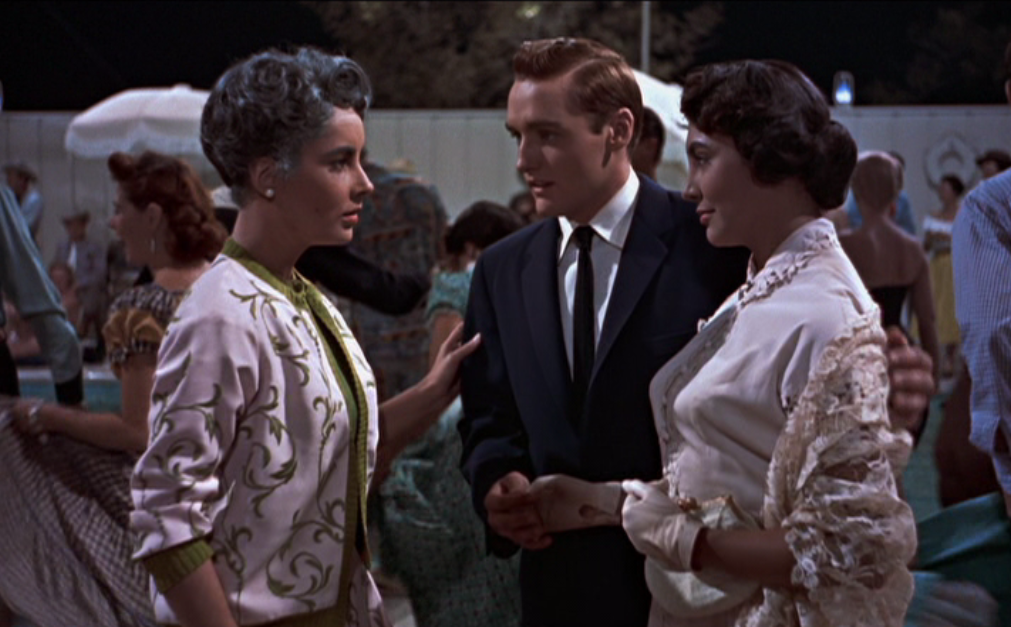
LESLIE: “Money isn’t everything, Jett.” JETT: “Not when you’ve got it.”
For the most part, the supporting cast is first-rate, including newcomer Carroll Baker, 24, as one of the Benedict daughters, a rebel who scurvy Jett (by then older and nastier) is dog-bent on seducing. She capped ’56 with her prude-enraging Baby Doll. Dean’s final performance (also 24, his fatal car wreck came right after his work was finished) captivated his fans and adds to the aura around the picture. It’s usually critically lauded, but the hold-yer-horses crowd have it that he’s quite good until his final scene, where his Method madness turns into an unintelligible slur, frankly lame. He, Liz, 23, and Rock, 29, all were required to convincingly age over the course of the storyline. Taylor’s very good (not the pill she’d shrill over in Raintree County, her next epic with another troubled young fella) and genial Hudson finally got a chance to be more than handsome and personable: this remains his best dramatic acting until Seconds a decade later. Bick’s/Rock’s heroic knockdown-dragout with a bigoted café owner at the climax is one of the great movie fistfights, a stirring example of winning through losing. Accompanying (perfectly) that donnybrook, a thumping rendition of “The Yellow Rose Of Texas”, was a #1 pop hit.

Stevens took home an Oscar for his direction and nominations went up for Best Picture, Actors (Hudson and Dean), Supporting Actress (McCambridge), Screenplay, Music Score, Art Direction and Costume Design.
The box office blowout of ‘Texas tea’ tapped $27,100,000 in America (how much of that where it was set?), with $5,756,000 more leased abroad. Re-releases saw another $5,000,000. *

With Chill Wills (Holy Alamo, an actual Texan in the cast!), Earl Holliman (in his doofus period, he did this in The Rainmaker and Forbidden Planet that year as well), Jane Withers (charming as sweet-natured ‘Vashti’), Charles Watts (perfect as a bloviating politician), Judith Evelyn, Paul Fix, Elsa Cardenas, Rod Taylor, Sal Mineo (“Angel Obregon comes home today“), Mickey Simpson (memorable as ‘Sarge’), Alexander Scourby, Victor Millan, Monte Hale, Sheb Wooley.

* Lone Star boosters (Texaco leaks to mind) had to be content with Giant‘s #3 spigot as the money gushin’ came down to Texas vs. the planet in Around The World In 80 Days,#2, and agin’ the Bible and The Ten Commandments, #1 by a Testament.
Bick’s & Jett’s aside, the state was well represented in 1956 thanks to The Searchers (#14, Duke out ‘fer blood), Written On The Wind (#17, with Rock) and down the llano a piece was The First Texan (#115), being Joel McCrea as he-bull Sam Houston.
Location—the southwest Texas town of Marfa, where much of it was filmed, boasts in 2023 a population of 1,748, down by half from what it had in the mid-50s. The Maryland sequences were done next door in Virginia; most of the interiors back at Warner’s in Burbank, California.

 Movies ala Mark