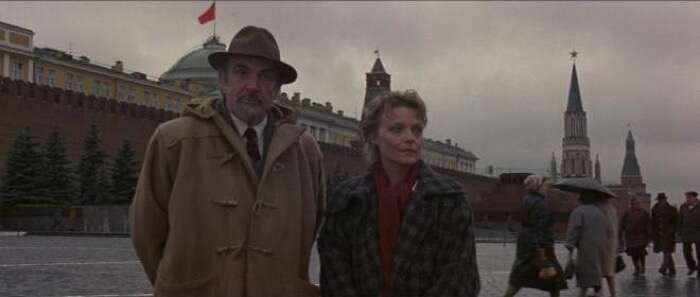
THE RUSSIA HOUSE opened as a Christmas release in 1990, a $21,800,000 project with high expectations. Sean Connery had scored a big hit earlier in the year with The Hunt For Red October, he was starring with Michelle Pfeiffer and a strong supporting cast in a script by Tom Stoppard, taken from the freshly published novel by John le Carré. Boosted by being only the second American-made film (preceded by the lame actioner Red Heat) shot in the quick-thawing Soviet Union, with further location work in Lisbon, London and British Columbia, it promised a novel setting, star power, intrigue, romance and topicality. Connery, back in the espionage game. Alas, taking the then-cooling temperature of the Cold War didn’t produce much heat; reviews, positive for the stars and scenery, were otherwise diffident, and it didn’t pull audiences, the $23,000,000 gross ranking a tepid 53rd in the States. In his book “The Films Of Sean Connery” author Lee Pfeiffer dubs it ‘From Russia With Lethargy’.
“Any decent church would have burned you bastards years ago.”
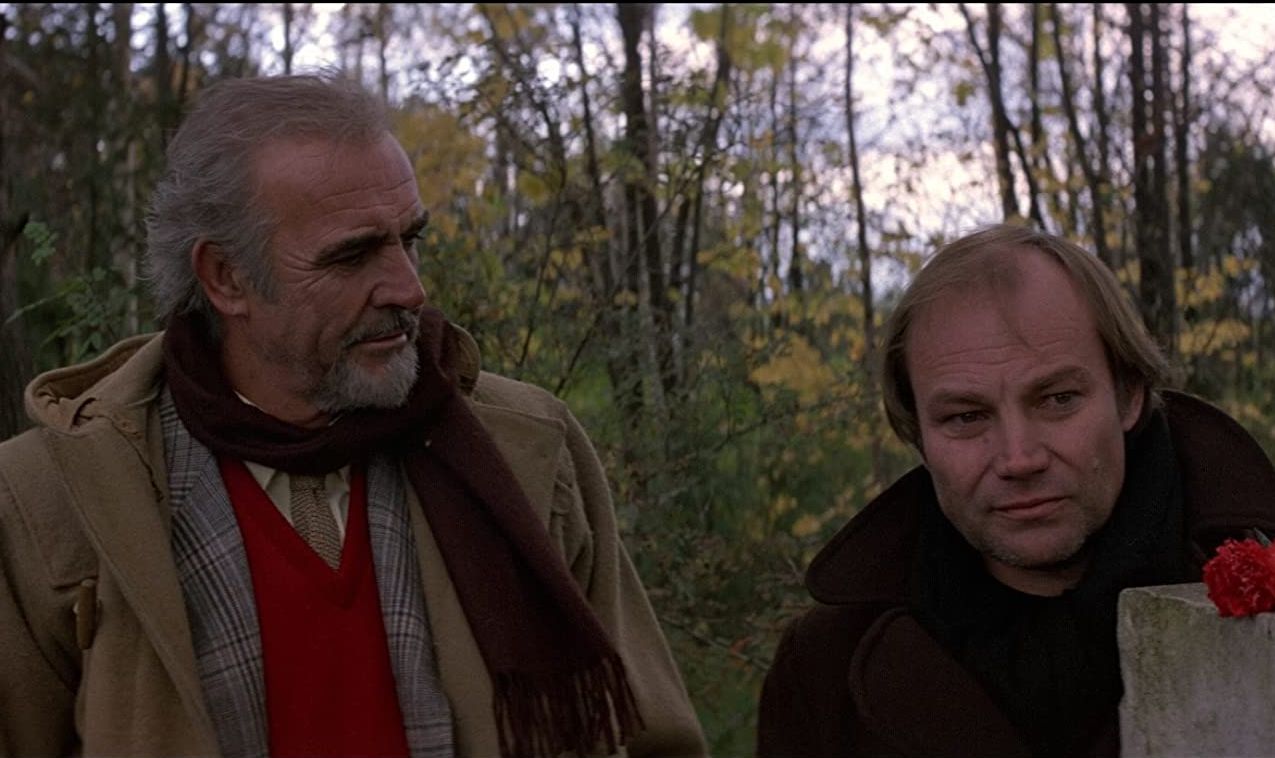
Book publisher ‘Barley Blair’ (Connery) is ‘recruited’ by MI6 (the title house refers to British Intelligence’s coy name for its Russia/Soviet department) to use his familiarity with and fondness for Russia to trace the sources and viability of information about the USSR’s nuclear readiness. Key to Barley’s snooping is guarded-yet-earnest ‘Katya Orlova’ (Pfeiffer) and her friend ‘Yakov’ (Klaus Maria Brandauer), brilliant mathematician and apparent dissident. The abrasive CIA joins unflappable MI6 in pressuring Barley, who has a healthy, well-founded suspicion of those who seem to want to keep international tensions taut: good for the arms business. But comrade Katya’s Russian soul has appeal too deep to deny.
“You are my only country now.”

Connery is very good, Pfeiffer excellent (her Russian accent superb), and the location shooting is a major plus, but Fred Schepisi’s direction leaches any suspense out of the excessively talky plot. Action isn’t expected in a le Carré product, but apart from a few good lines, Stoppard’s script feels awkward. It’s not hard to follow, just tasking to get emotionally engaged with, and the bicker banter between the assorted spy masters is forced and obvious. The charismatic leads do their best (try and de-glam Pfeiffer, she remains incandescently striking); the you-are-there views of Moscow and Leningrad/St. Petersburg are more telling than the plot.
123 minutes, scored by Jerry Goldsmith, with Roy Scheider (served poorly by the script), James Fox, Ken Russell (the flamboyant director playing a flamboyant spook, a lame miscalculation in casting and writing), John Mahoney, Michael Kitchen, J.T. Walsh (hardass mode), David Threlfall, Christopher Lawford.

 Movies ala Mark