
ALL QUIET ON THE WESTERN FRONT first appeared on screen a year after Erich Maria Remarque’s novel “Im Westen nichts Neues” (‘Nothing New In The West’) became an international sensation, selling 2,500,000 copies in 22 languages within its first 18 months of publication. Former German soldier Remarque (1898-1970) based the 200 pages on his WW1 experiences. The first of three acclaimed film versions took one of earliest Oscars as Best Picture (the Academy in its 3rd year of awarding) and director Lewis Milestone earned one for his superb direction. The script by George Abbott, Maxwell Anderson and Dell Andrews was nominated as was Arthur Edeson’s startling cinematography. Big-scaled ($1,200,000 expended, 2,000 extras employed), after initial release in Spring of 1930 it was trimmed a bit and surviving prints run 133 minutes. Heading toward a century later, it holds up remarkably well. *

Egged on by the fervent patriotic exhortations of their nationalistic professor (great work from Arnold Lucy), an entire class of teenage boys enlist in the German Army during the First World War. It isn’t long before they realize what they’ve signed up for. As his pals are decimated in fruitless battles, thoughtful ‘Paul Bremer’ (newcomer Lew Ayres, 21) bonds as comrade with heartily rugged veteran ‘Kat’ (Louis Wolheim, excellent), survives a wound, and after a dismal furlough home, returns to the line.

Unlike most early sound pictures, the acting in this intense drama is quite good, and the new-fangled sound helped bring a sense of the war’s shattering racket. That, combined with the sterling camerawork, Milestone’s fluid direction (distinguished by his immersive tracking shots that would become effectively a trademark) and outstanding choreography (did extras get clobbered by those huge explosions?) in the battle scenes make for a riveting watch. The stills we include here speak better than any wan attempt at description.

The 7th most-attended picture of 1930 with a domestic gross of $4,600,000, it was also a success overseas, except in Germany, where the nascent Nazi party, led by another trench veteran with a decidedly different outlook than Remarque’s, managed to get it banned.
With John Wray, Slim Summerville, Ben Alexander, Russell Gleason and Beryl Mercer. One of those 2,000 extras was 22-year-old future director Fred Zinnemann.
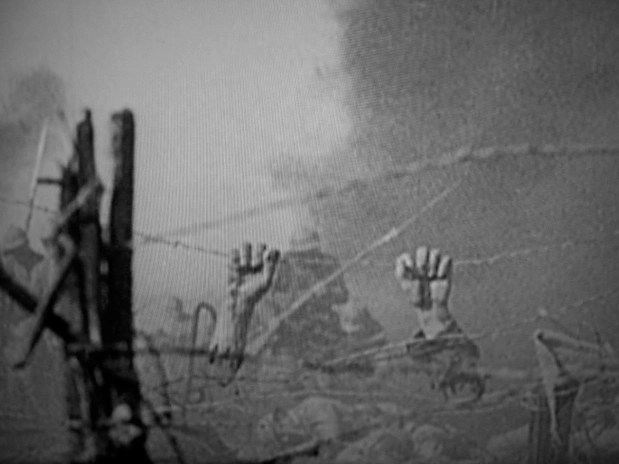
* Germany put 13,000,000 men into uniform for the 1914-18 horror show. More than half became casualties. 1,152,000 were captured, 4,216,058 were wounded, 1,773,700 were killed.

Rather more sanguine statistics—in 1930, the U.S. population was 123,202,624 and average weekly movie attendance was 90,000,000. There had been a few silent films about WW1, notably The Big Parade, The Four Horsemen Of The Apocalypse, What Price Glory? and Wings but pacifism was the mood in 1930, which saw more revisits to The Great War in Hell’s Angels (the year’s #1 hit), The Dawn Patrol (#15) and Journey’s End (105th).
Influenced by the film, when WW2 came Lew Ayres registered as a conscientious objector. He enlisted, serving not with a rifle but as a medic, serving with distinction in the bloody retaking of The Philippines.
All Quiet On The Western Front was redone (and very well) for TV in 1979, then spectacularly for the big screen in 2022.

 Movies ala Mark