
FRIENDLY PERSUASION, winning Civil War-set Americana directed by William Wyler, was a big hit in 1956, #12 for the year, notching six Oscar nominations. Ironically, the inside story behind the one on screen reflected the country’s then (and ongoing) contagious political divides: one of those nominations, Screenplay, caused a house-divided rift because screenwriter Michael Wilson, adapting Jessamyn West’s episodic novel a decade earlier, had in the interim been blacklisted. Besides the tift over a ‘Commie & peace-tinted’ script, the other Oscar bids were for Best Picture, Director, Supporting Actor (Anthony Perkins), Sound and the title Song. *
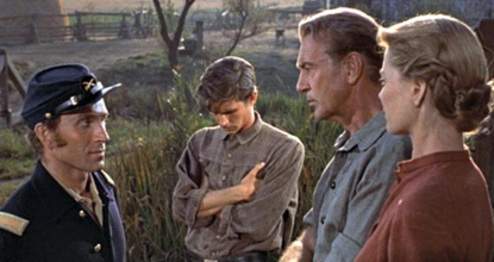
Indiana, 1862. Good-natured farmer ‘Jess Birdwell’ (Gary Cooper, 54) heads a Quaker family, sharing decision making with ‘Eliza’ (Dorothy McGuire, 39), his somewhat more pious wife, steering the straight & narrow course for elder son ‘Josh’ (Perkins, 23), rambunctious youngster ‘Little Jess’ (Richard Eyer, 10) and pining teenage ‘Mattie’ (Phyllis Love, 30, looking 17). With the War Between The States underway, Mattie falls for a local fella who’s become a Union officer (Mark Richman, debut and his most likable part ever), and when Confederate cavalry approach (based on ‘Morgan’s Raid’ of 1863) the Birdwell’s staunch faith and non-violence tenet is put to the supreme test.

Smartly written, carefully directed, beautifully acted period piece moves into drama in the last act with the raid segment, but the bulk of the leisurely inviting journey to decision crossroads is composed of home and community vignettes that are charming—Mattie’s blooming romance, Jess and Eliza’s to & fro over issues—and frequently great fun—the little boy’s contest with the family’s pet goose (Eyer one of the best, least affected child actors of the time) and especially when Jess and Josh pay a visit to the ‘Widow Hudspeth’ (Marjorie Main) and her three man-crazy daughters. In only his second film, Perkins shines (he and Cooper have great rapport) with gawky likability, and stage/TV actress Love is endearing in one of just three films she logged. Often cast as bad guy (a real brute in director Wyler’s The Desperate Hours), Robert Middleton gets a nice reprieve here as a jolly neighbor who has friendly buggy-race competition with Jess.
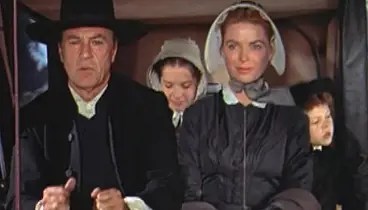
The only detriments in this excellent, truly warm-hearted family film are Dimitri Tiomkin’s over-emphatic score and some jarring process photography (standard for the day) during the buggy races.
Costing a little over $3,000,000 (Wyler going 50% over budget), it amassed a gross totaling $14,400,000. The friendly gift of this picture was more persuading than the other big Civil War pix that came out the following year, the overblown Raintree County and a wan attempt to stir GWTW aura with Band Of Angels.
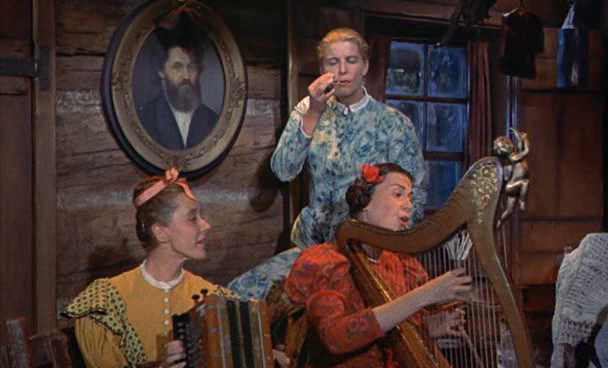
Lots of familiar faces in the crowd: Walter Catlett, John Smith, Joel Fluellen, Russell Simpson, James Anderson, Richard Hale, James Dobson, William Schallert, Charles Halton, Billy Curtis, John Dierkes, Robert Fuller, Doug McClure (20, debut), Joe Turkel. We can’t leave out The Widow Hudspeth’s daughters: Edna Skinner, Marjorie Durant and Frances Farwell. And of course ‘Samantha’, goose. Pat Boone sang the title tune. 140 minutes.

* The joke was on the Academy Award commissars that year. While denying the blacklisted Wilson from having his name on the ballot they outfoxed themselves by giving the year’s Best Story award to ‘Robert Rich’ for The Brave One. Whoops!—Rich was actually blacklisted Dalton Trumbo. As it was, Wyler, his brother Robert and author West substantially rewrote Wilson’s script, which resulted in another who-did-and-deserved-what brouhaha. A Marx, not Karl, got the best laugh out of the farce. Groucho: “take, for example, The Ten Commandments. Original story by Moses. The producers were forced to keep Moses’ name off the writing credits because they found out he had once crossed the Red Sea.”

Coop, commenting on Perkins in a Life cover story: “I think he’d do well to spend a summer on a ranch. It would toughen him up and he’d learn from another kind of people.” Uh, maybe.
Perkins, on the legendary star and painstaking director: “…they would discuss things in a very, very technical way. Wyler would literally say, ‘When you come to this word, stop and swallow, then continue.’ Cooper would listen to this, and when he actually did it, it was magic….It was Cooper’s artistry that he could translate a technical direction into something very soulful.”

Phyllis Love, 1925-2011

 Movies ala Mark