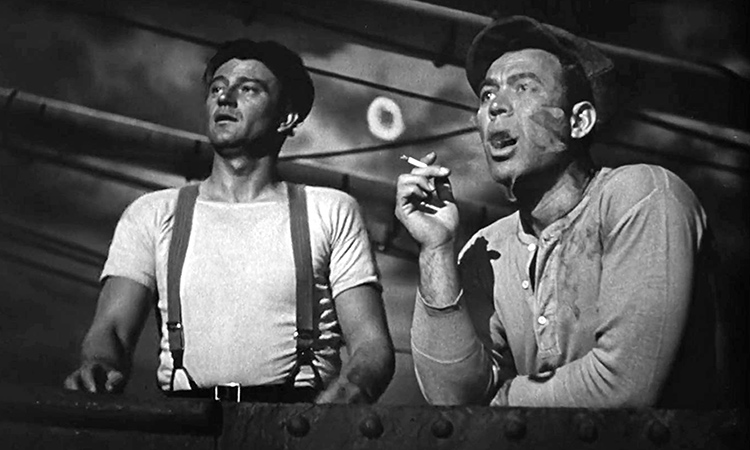
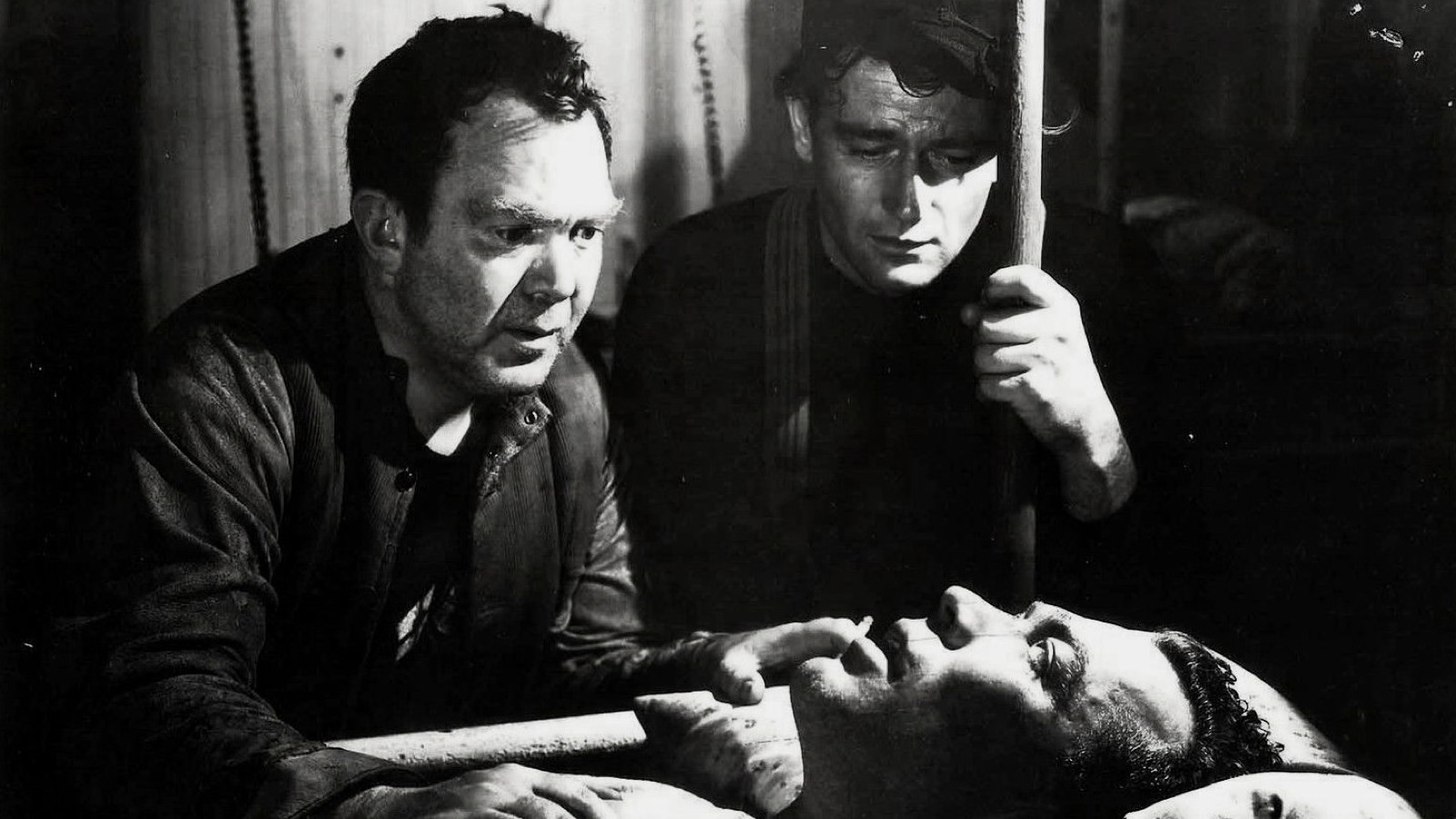
THE LONG VOYAGE HOME was a critical success when released and retains undimmed status as a classic today, thanks to director John Ford, a stalwart lineup of some of his favorite players and cameraman Gregg Toland, all creating an artistic masterpiece from stories by playwright Eugene O’Neill. Yet audiences of 1940 didn’t flock to the somber, doom-portending mood of the piece enough to make it a box office win, possibly because darkening war news had them mostly averse to downbeat material and this picture, in the words of Ford biographer Joseph McBride, conveys “an omnipresent atmosphere of fear and resignation, stifled sensuality and profound loneliness”. *
“Best thing to do with memories is…forget ’em.”
Following a lusty carouse with local damsels in a West Indies port, the crew of the ungainly tramp steamer SS Glencairn leave for England after first picking up a load in Baltimore. Their salt-weathered and booze-infused complaining is a given, but on this trip three elements are keen. They’re irate over the cargo, war material, which makes them a target; they’re suspicious of one aloof crewman’s loyalties; and they all agree that the youngest and nicest fella aboard needs to get ashore and stay there, away from the life that has them self-ensnared in a self-erasing whirlpool.
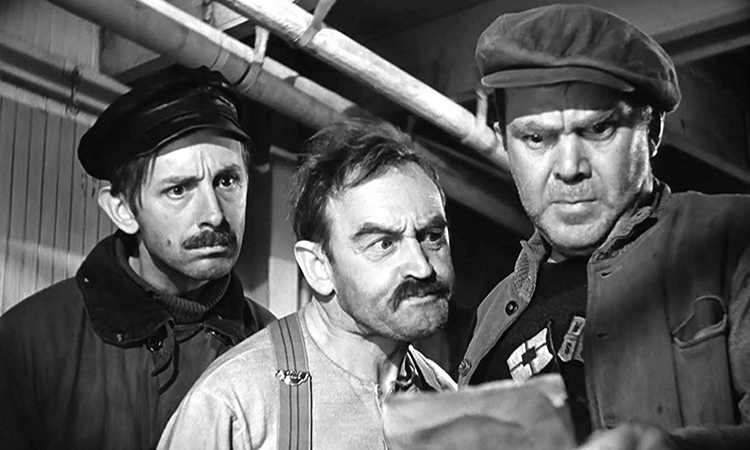
“Is there any place on land or sea where there is no war? Everywhere people stumbling in the dark. Is there to be no more light in the world?” The bellowed lament ends with “Is there no place in this dark land where a man who’s drunk can find a decent bit of fog?” Tellingly, like many of the crew (in the ship and on the film), O’Neill and Ford were plagued by liquor, but this show doesn’t play alcoholism as a joke but rather as a curse. The film’s opening and concluding brawls aren’t played for humorous Fordian donnybrooks like those in The Quiet Man, The Wings Of Eagles or Donovan’s Reef.
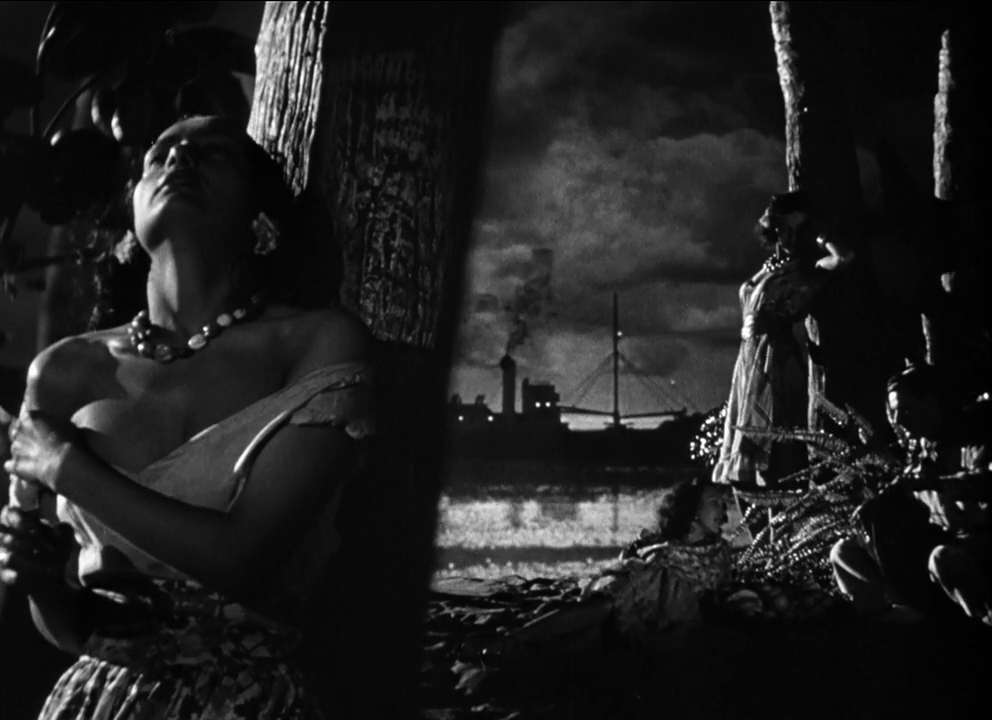
Dudley Nichols skillful screenplay meshes a quartet of O’Neill’s one-act plays centered on the sea—“The Moon Of The Carabees”, “Bound East For Cardiff”, “The Long Voyage Home” and “In The Zone”, updating them from their WW1 era setting to 1940 and a new and widening conflict. Nichols and Ford mine O’Neill’s ‘lost soul’ speeches for their essence, reducing them to brisk and bracing exchanges and elegiac pictures worth the proverbial thousand words. Ford loved the sea, understood its hypnotic pull, and shared O’Neill’s heritage-suffused Irish sense of dislocation, the great Celtic diaspora echoed in longing, bitterness and pride. The visualization of the theme of separation and the seaman’s lot—escape is also a trap, the vast expanse of the sea in paradox with the cramped confine of a vessel—was tasked to cinematographer Gregg Toland, who’d just done marvelous work for Ford on The Grapes Of Wrath. His masterful deep focus interplay of light & shadow was such an integral part of the presentation that he was accorded shared billing with the director. His compositions would influence his work on Citizen Kane and the emergence of the film noir ‘look’. Throughout, the direction and camerawork are remarkable, starting with the memorably erotic opener with the port’s prostitute contingent’s writhing invitation on a sultry Caribbean evening; hot stuff for the day. The roaring storm sequence makes splendid use of sound and special effects, and Richard Hageman’s scoring allows the haunting “Harbor Lights”, plus Ford clearly goosed him to sneak in a quick bit of “Garryowen”.
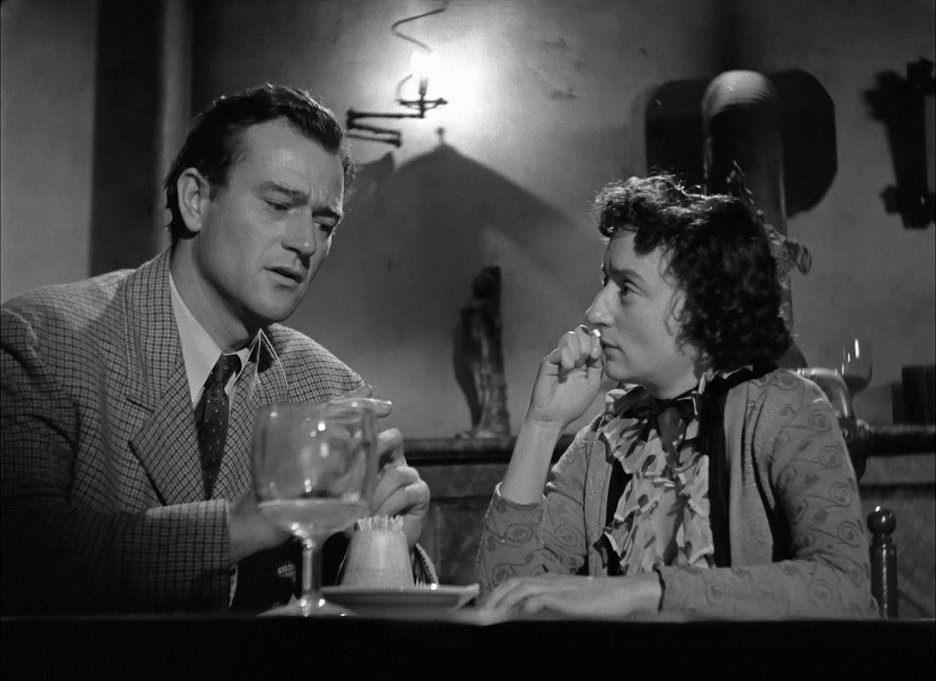
The cast excels. His star finally risen after Stagecoach, John Wayne is first-billed, employing an okay accent as ‘Ole Oleson’, the gentle, rather innocent Swedish fella who the others are determined won’t follow them back into the misery-go-round. The Duke’s fine, but he’s really just part of the ensemble, and in support of character great Thomas Mitchell as ‘Driscoll’, the unofficial leader of the rank & file crew. On deck are Ian Hunter as the drink-battered, guilt-laden ‘Smitty’; Barry Fitzgerald as ‘Cocky, a sly rumor-monger; Ward Bond in one of his best early parts as the rough & tumble ‘Yank; Wilfrid Lawson as the tough-but-fair captain; John Qualen, doing his patented Scandinavian sputter as ‘Axel’, Ole’s minder; tough-mugged Joseph Sawyer as bruiser ‘Davis’; jovially devilish J.M. Kerrigan as ‘Crimp’, the hateful shanghai scout; Mildred Natwick, in a nuanced and sensitive turn as ‘Freda’, a sad hooker working in concert with Crimp.
Academy Award nominations came for Best Picture, Screenplay, Cinematography, Film Editing, Music Score and Special Effects. Made for $689,495, under the aegis of producer Walter Wanger the release was boosted by enlisting nine prominent artists (including Thomas Hart Benton and Grant Wood) to create paintings advertising the film. Alas, critic and peer applause didn’t translate to the all mighty green. The movie is always cited as a financial casualty, with gross figures varying from $589,129 to Cogerson’s (questionable) tabulation of $1,900,000, 106th place among 1940’s very impressive lineup. Ford took home a directing Oscar for his other Best Picture nominee The Grapes Of Wrath.
105 minutes, with Arthur Shields, Carmen Morales and Jack Pennick.

* With Hitler humbling Europe and Japan ravaging China, going to a movie and walking out sad held limited appeal. Of the 30 most popular releases that year, only Rebecca and The Grapes Of Wrath really took people through an emotional wringer.
Among those who smiled in gratitude over The Long Voyage Home was Eugene O’Neill. Hollylore is rife with so many instances of the movies mauling authors stories in adaptations that it’s nearly axiomatic that the original writer will carp (having taken the money first) but occasionally there’s a happy confluence of art and craft. O’Neill wired Ford: “My congratulations on a grand deeply moving and beautiful piece of work.” Ford: “He loved it. And that’s probably the greatest professional compliment I’ve ever had.”
Dudley Nichols teamed with Ford fifteen times. The others—Men Without Women, Born Reckless, Seas Beneath, Pilgrimage, The Lost Patrol, Judge Priest, The Informer, Steamboat Round The Bend, Mary Of Scotland, The Plough And The Stars, The Hurricane, Stagecoach, The Battle Of Midway and The Fugitive.
 Movies ala Mark
I need to see this one if only because I’ve never seen Mildred Natwick as a young woman ( although from the photo above she looks damn fine).