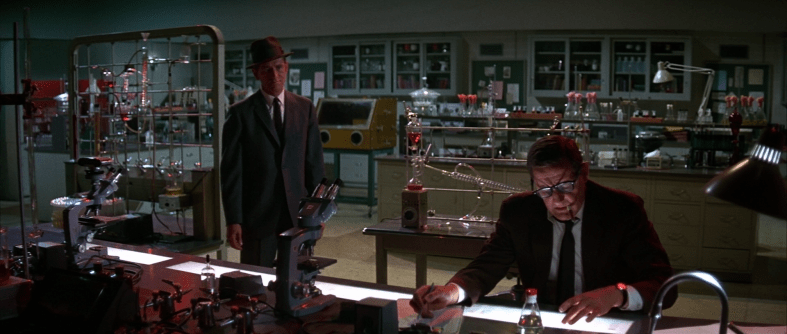
THE SATAN BUG—-coming on the heels of a slew of USA vs. Russia accidental-atomic-wipeout movies, this summer of 1965 suspense thriller used the obscene possibility of biological annihilation to take nervous viewers minds off Vietnam, race riots and the worry that across the Pole, in a silo outside Minsk, some guy named Fyodor wearing a size-19 cap was balancing a bottle of Smirnoff on his nose while holding a finger over a button marked ‘Des Moines’.

Sadly, the premise could be easily updated. Unhinged scientist Richard Basehart has a vial containing enough pathogen to kill every last thing on the planet, and to prove he’s not merely in need of some sick days, he dumps a sample on Florida. Director John Sturges, riding the crest from The Great Escape, put scribe pros James Clavell and Edward Anhalt onto refashioning an Alistair MacLean story.
The movie came off as a near-miss, definitely worth watching for its successful elements: a bit lamentable in its follow-thru. The story is good, and cameraman Robert Surtees makes use of expansive locations outside Palm Springs. The scoured, open spaces of the desert suggest something mercilessly cleansing lurks in the bright heat, and the silent underground laboratory settings are properly ominous. Ever have that odd, shoulder-rumpling sensation, driving thru the parched and lonely outlands, that some Big Bad Shit is stockpiled down that arroyo? And if you turn in there to have a look—hey,its a free country—you won’t get out?
 The supporting cast is peppered with stalwarts of the era, fellas like Simon Oakland and John Anderson, and a couple of nasty bad guys in Frank Sutton and Edward Asner. (This could be known, in wag circles, as the movie where ‘Sgt.Carter’ and ‘Lou Grant’ poison ‘Scotty’, since James Doohan has a die-on bit.) Basehart nails the best role, with the choicest lines, while old pro Dana Andrews doesn’t have much to do beyond look concerned. Eerie backdrop is provided by a creeped-out, electronic-tinged score from Jerry Goldsmith: his music behind the nifty credits sequence gives the show a solid kickoff.
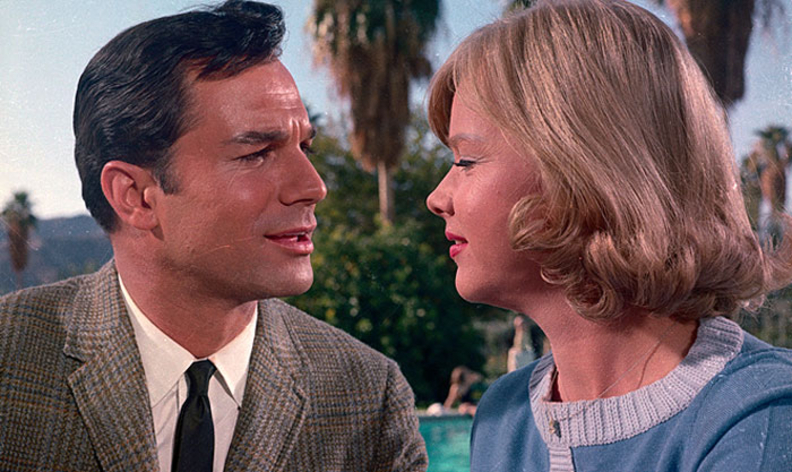 On the other end, at the helm, Sturges dropped the ball. His direction went slack: he was spending more time planning his next project, The Hallelujah Trail, than he was with his actors, who expressed dissatisfaction. The leads are another problem. George Maharis, fresh off Route 66, is just so-so as the hero of the piece, and Anne Francis as the leading lady doesn’t click. To be fair to Francis, the leading man, script and direction let her down. In a movie centered around chemistry, it’s a dicey experiment when the leads have limited amounts of it.
Sturges got mad at Los Angeles city officials for not allowing him to shoot his planned finale, which would have involved shutting down a large section of the freeway system!
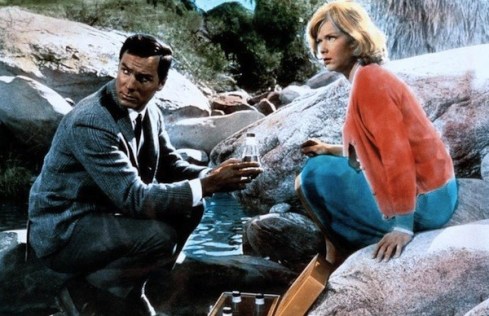
Accomplished for $1,800,000, running 114 minutes, with Richard Bull, Harry Lauter, James Hong, Hari Rhodes and Harold Gould. Look quick and you’ll see Lee Remick doing an unbilled bit as a waitress (she was tabbed as the lead in The Hallelujah Trail.)
This is the sort of forgotten film that people happen upon and say “huh, that was kinda cool…never heard of it”. It only grossed $2,600,000, placing 89th in the year of Thunderball, with audiences opting for charisma over consequence, spear guns over speculation. Meanwhile, as to those stockpiles of mankind-murdering molecules….
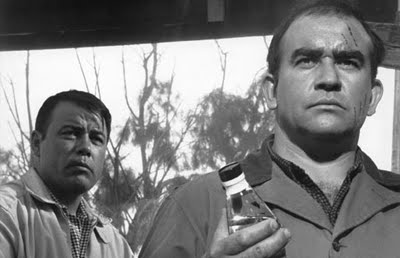
Give us long running comedy series or we end life on earth.

 Movies ala Mark